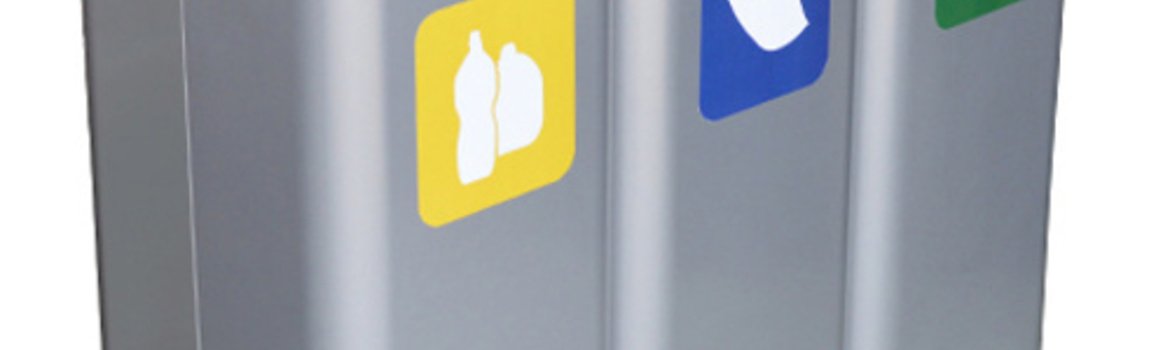
For offices and schools, the best choice is recycling bins with coloured lids from a single series, grouped into shared recycling stations: one bin each for paper (blue), plastic and metal (yellow), glass (green) and mixed waste (grey or black). In a small office or classroom, 20–28 l bins are enough; in corridors, canteens and larger offices, 50–90 l; and in lobbies or retail spaces, an enclosed multi-compartment bin is convenient. Below – how to work out the quantity, which size and material to choose, and which models suit specific locations.
When there is only one small bin at each desk or in a classroom, everything ends up as mixed waste. A shared recycling station – several bins of different colours placed side by side – lets people put waste in the right place straight away, and cleaners have fewer bins to empty. We wrote more about how to introduce such a system at work and get employees involved in the article How to sort waste at work the simple way. In this article we focus mainly on the bins themselves: which ones and how many to buy.
There is no exact formula – the amount of waste depends on whether people eat on site, how much is printed and whether deposit packaging is collected. So as a rough guide, we suggest basing your choice on the location and footfall:
How many stations do you need? In practice, one station in every area where waste is generated: by the kitchenette, on every floor by the stairwell or lift, in the canteen, by the gym. Two smaller stations at different ends of the building are better than one big one that nobody walks to. After a few weeks, see which bins fill up fastest – replace them with bigger ones or empty them more often.
Which fractions do you need? Usually four are enough: paper and cardboard, plastic and metal, glass, mixed waste. In a school or office where people eat, a bin for food waste is also useful. A red lid can be used for batteries, small electronics or ink cartridges – just label it clearly. Check the exact fraction arrangement with your waste management company.
| Model | Key data | Where it suits |
|---|---|---|
| Fit Bin 20 l (blue, yellow, green, grey, red lid) | 20 l, 265 × 235 × 510 mm, opening in the lid | offices, classrooms, staff room |
| Mini EcoBin 28 l | 28 l, 360 × 290 × 500 mm, fits under a desk | small office, kindergarten, kitchenette |
| Fit Bin 53 l | 53 l, 330 × 330 × 730 mm | office kitchenette, corridor |
| EcoBin 50 l | 50 l, 412 × 412 × 640 mm, also suitable for deposit packaging | school corridor, office |
| Fit Bin 75 l | 75 l, 390 × 390 × 730 mm, the largest bin in the series | canteen, gym, lobby |
| EcoBin Big 90 l | 90 l, 850 × 530 × 405 mm, metal ring to hold the bag | canteen, high-footfall areas |
| 3-compartment recycling bin 77-62 | 3 × 70 l, painted galvanised steel, lockable lid with gas struts, 33 kg | lobby, business centre, university |
| Brabantia office bin 7 l / 15 l | brushed steel, open top, 10-year manufacturer's warranty | by the desk, office, meeting room |
You'll find all colour and size options in the Recycling bins category.
In an office the logic is the same: small bins at workstations or none at all, one full station by the kitchenette and printing area, and an enclosed multi-compartment bin in the lobby.
A coloured lid is half the job, but it's worth hanging a short reminder with icons above the station: what goes into which bin and what must not be thrown in. Pictures work well in schools, a short list in offices. You'll find what goes into which container in the waste sorting cheat sheet. Plastic bins just need washing with water and ordinary detergent; the smooth surface dries quickly.
How many recycling bins does an office need?
Most offices need one station of 3–4 bins in every area where waste is generated – by the kitchenette, the printing area, on every floor. Roughly: for an office of up to 10 people, 20–53 l bins are usually enough; for a larger one, 53–90 l.
Which colour bins for which waste?
Under the usual system, blue is for paper and cardboard, yellow for plastic and metal, green for glass, brown for food waste, and grey or black for mixed waste. Red is often used for batteries or small electronics.
Can deposit packaging be collected in the same bin?
Yes, the EcoBin 50 l, Fit Bin 75 l and EcoBin Big 90 l bins are also suitable for collecting deposit packaging – just label the bin clearly. More on this in the article Containers for deposit packaging.
Can the bins be placed under a desk or in a cabinet?
Yes, the Fit Bin 20 l and Mini EcoBin 28 l bins are compact enough to fit in a cabinet or under a desk.
How is a multi-compartment bin better than several separate bins?
It takes up one spot, looks like a single piece of furniture and has a lockable lid. The 3-compartment bin 77-62 has three 70 l plastic inserts, and the compartments can be marked with coloured stickers.
We deliver by Venipak courier throughout Lithuania – 9.99 € incl. VAT; goods in stock are delivered within 1–3 working days. For schools, kindergartens, offices and business centres we'll prepare a quote for a complete recycling system with an invoice – Request a quote.


 Business Excellence Award 2026